
Reviewed · SWAKOPMUND
City Tour of Historical Swakopmund
Swakopmund’s old center feels like a slice of early-1900s Germany set beside the Namib Desert and Atlantic Ocean. This two-hour tour connects its most notable buildings, from the timber-framed Woermannhaus to the iron jetty, while guide Hans-Dieter explains how the town grew from a colonial port into Namibia’s best-known seaside resort.
I like the way the tour uses actual buildings to tell its story, rather than relying on a long lecture. I also like the personal angle Hans-Dieter can bring, drawing on family ties to Germany and a lifetime in the area. The main thing to consider is that this is a short, mostly historical town tour, so anyone wanting a broad look at modern Swakopmund or nearby desert attractions may need another outing.
Key points to know before you book
- Woermannhaus gives you the best architectural opening: Its 1894 timber construction, later additions, courtyard, and Damara Tower show how important trade was to early Swakopmund.
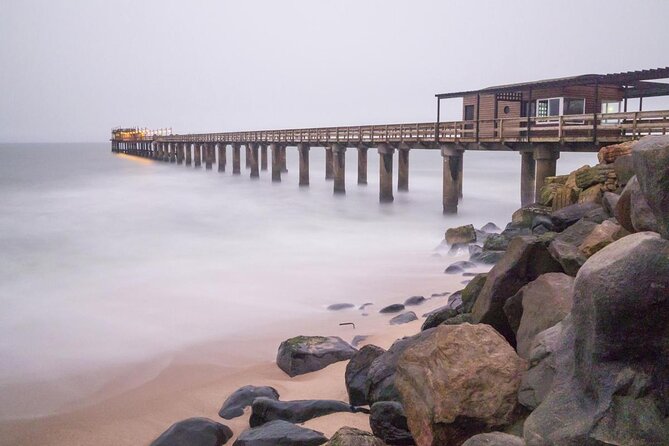
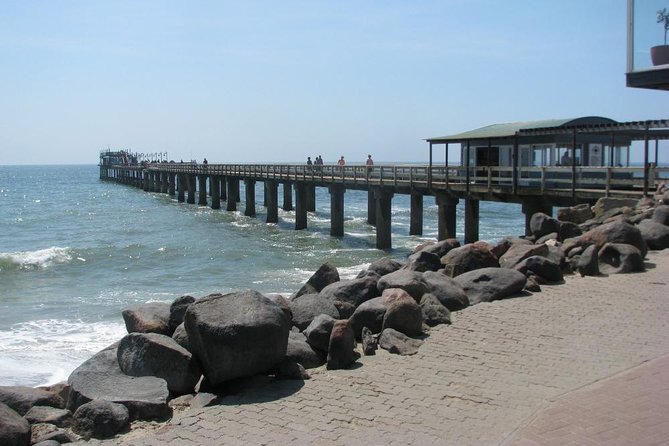
- The 1912 iron jetty explains the town’s purpose: Built to replace a wooden structure, it reached only 262 meters after the First World War interrupted construction.
- Hans-Dieter is the guide to look for: His background and long connection with Swakopmund add local detail to the buildings and events.
- The route is compact but packed with stops: Six sites are covered in roughly two hours, with short visits at most locations.
- The German character is central to the tour: Neo-Baroque design, imperial decoration, military memorials, and German church traditions all appear along the way.
- The price is reasonable for a small-group history walk: At $37.16 per person, the value depends on how much you want explanation and local context rather than independent sightseeing.
Why Swakopmund’s old center is worth your time
Swakopmund is often treated as a base for adventure activities, but its town center deserves attention on its own. The streets contain a cluster of German colonial-era buildings that remain in use, giving you a chance to see how architecture, trade, military planning, religion, and daily life shaped the town.
The setting makes the story unusual. German-style buildings were put up in a dry coastal environment far from Europe, using designs and materials suited to the ambitions of the colonial administration and trading companies. The result is a town that can feel visually unexpected, especially when ornate façades appear against the spare Namibian coast.
This tour focuses on that historic core. You meet at the Swakopmund Museum on Strand Street, then return there at the end. That makes the outing easy to fit into a morning or afternoon, especially if you are staying near the center or arriving by public transport.
The group can include up to 25 people. That is not an intimate private walk, but it is still small enough for a guide to explain details at each stop. If you want to ask questions, do so early. The tour moves through several locations in a limited time.
More history tours in Swakopmund:
- Swakopmund Best Cultural Historical Township Tours Namibia
★ 5.0 · 8 reviews - Explorer Historical Private Township Cultural Tours
★ 4.0 · 6 reviews - Half Day Swakopmund Cultural Historical Township Tour
★ 5.0 · 4 reviews
Woermannhaus and the business of early Swakopmund
Woermannhaus on Bismarck Street is the first major stop, and it is a good place to begin because it connects architecture with commerce. Built in 1894 by the Damara and Namaqua Trading Company, the building later expanded in 1903 and 1904 with wood-paneled offices.
Its design follows architect Friedrich Höft’s Fachwerkbau style. The timber-framed look gives the building a distinctly German appearance, but its purpose was practical. This was the headquarters of one of the leading trading companies in what was then South West Africa, later known as Woermann, Brock & Co.
The building also housed selected company officials and employees in 1909. That detail helps you see it as more than a handsome façade. It was an office, residence, and symbol of commercial power in a young port town.
Look for the Damara Tower at the northwest corner. It served as a lookout, flag mast, and navigation point. The old courtyard was once filled with an evergreen garden, an interesting contrast to the dry surroundings today.
You spend about 30 minutes here, the longest stop on the route. That gives the guide room to explain the building’s changes and point out architectural details. If you enjoy old buildings, this is likely the most rewarding stop for close inspection.
The building’s story also deserves a thoughtful reading. Its beauty reflects German construction traditions, while its original role reflects the trading system and colonial control of the period. The tour is strongest when it lets you appreciate both facts at once.
The iron jetty and Swakopmund’s difficult harbor
The Swakopmund Jetty shifts the story from offices to infrastructure. The iron structure was built in 1912 to replace a wooden jetty that had deteriorated. Two firms from Mannheim received the contract, and the original plan called for a jetty 640 meters long.
Construction proved difficult because of the rocky seabed. The builders had to develop a drilling program to deal with those obstacles. When the First World War began, work stopped, leaving the jetty at 262 meters.
You spend about 15 minutes here, so expect a focused explanation and time to look at the structure rather than a long stop. The jetty is valuable because it shows the practical problem behind Swakopmund’s early development. A port town needed a reliable way to load and unload goods, yet the Atlantic coast was not easy to work with.
The structure was built well enough to withstand more than 70 years of Atlantic pounding with little or no repair. That durability is one of the more memorable facts on the route.
This stop is also a reminder that Swakopmund’s town center did not grow by accident. Trade required engineering, transport links, storage, offices, and workers. Once you understand the harbor problem, the commercial buildings make more sense.
The jetty itself is a practical photo stop, but the value here comes mainly from the explanation. If you visit independently, it is easy to see the iron structure without understanding why it was built in that form or why it ended shorter than planned.
Prinzessin-Rupprecht-Heim and changing military use
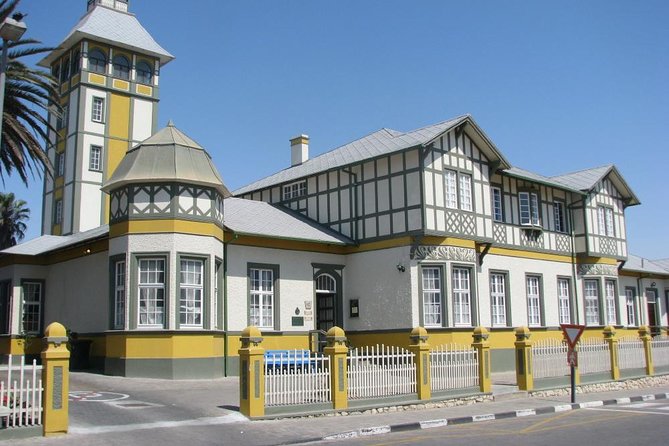
The Prinzessin-Rupprecht-Heim offers a look at military and charitable life in the early years of the town. Built in 1902, it was first used as a military hospital and occupied that same year.
The hospital closed in 1909 and later became a convalescent home in 1911. Two years after that, the Bavarian Women’s Association of the Red Cross took over the building and arranged major renovations funded by a donation of 35,000 marks.
You spend around 20 minutes here. The stop is less about one dramatic architectural feature and more about changing use. A military hospital became a recovery home, then came under the care of a women’s Red Cross organization. Those changes reveal how institutions adapted as the town developed.
The building was named for Princess Rupprecht, patroness of the Bavarian Association and wife of the heir to the Bavarian throne. That name ties a local structure to the wider German political and social world of the time.
The title Hotel Prinzessin Rupprecht may appear in maps or booking systems because the building is associated with a bed-and-breakfast operation. The tour’s focus, however, is its earlier role and architectural history.
A few more Swakopmund trips worth a look
- Walvis Bay: Marine Big 5 Luxury Catamaran Tour
★ 4.8 · 1,012 reviews - Swakopmund: Desert Dunes Quad Biking with Optional Sandboard
★ 4.9 · 590 reviews - Walvis Bay and Sandwich Harbour Tour
★ 4.8 · 483 reviews - Scenic Sandwich Harbour Tour
★ 5.0 · 277 reviews
Haus Hohenzollern and decorative imperial style
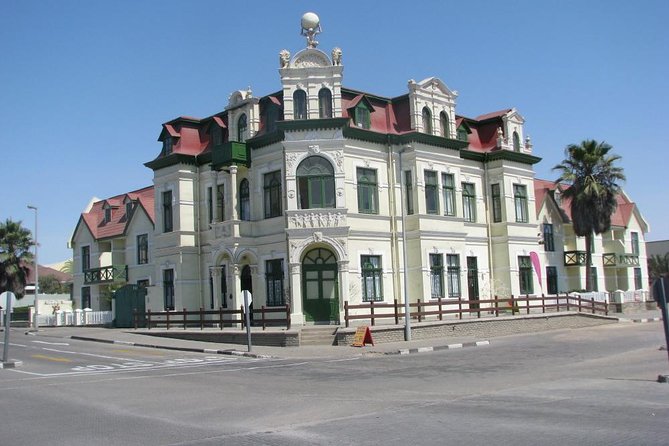
Haus Hohenzollern is one of the most visually elaborate buildings on the route. Constructed between 1904 and 1906, it was once a hotel and remains one of the more unusual examples of German architecture in Swakopmund.
The decoration is easy to spot. Cupid figures and flowers add a playful touch, while the corner pediment has two lions. At the top, an imperial image of Atlas carries the world on his shoulders.
You spend roughly 15 minutes here, enough to examine the façade and hear why the building mattered. Haus Hohenzollern rises above nearby structures, so it has a strong presence in the street.
I find this stop useful because it shows that colonial architecture was not always plain or strictly practical. The designers also used decoration to convey status, confidence, and connection to imperial culture.
At the same time, the building should not be viewed only as a charming European curiosity. Its symbols reflect the political order of the period. A good guide can explain the style without separating it from the colonial setting that produced it.
The Lutheran church and a congregation finding its footing
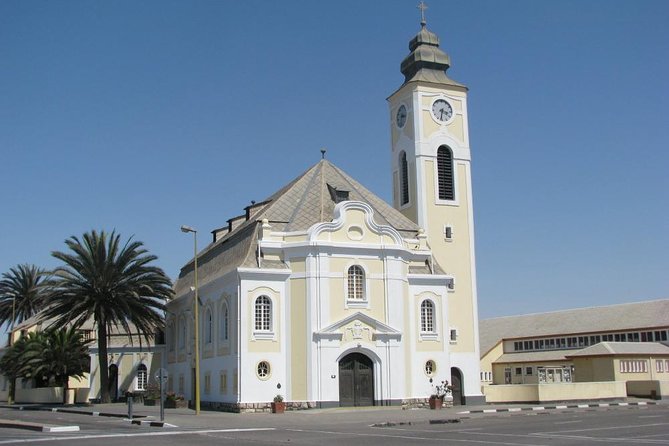
The German Evangelical Lutheran Church, together with its parsonage, adds a religious chapter to the walk. One local story tells of Pastor Vedder holding open-air services in 1905 that attracted no one. He supposedly returned to his home, a roofless wooden crate without doors or windows, with his sermon still unread.
The story is memorable because it captures how basic conditions could be in the early town. By 1909, the congregation was working on plans for a proper church.
Architect Ertl designed the building in the Neo-Baroque style. F. H. Schmidt received the construction contract in 1910, at a cost of 85,000 marks. The church’s three bells were cast by Franz Schilling in Apolda, Germany.
You spend about 20 minutes here. The stop works best if you pay attention to the combination of design and logistics. The church was not simply built for decoration. It marked the point at which a settled congregation had the organization and money to create a formal place of worship.
The adjacent parsonage helps complete the picture. Together, the two structures show how religious life became part of the town’s permanent institutions.
The supplied details do not promise an interior visit, so you should expect the guide to concentrate on the exterior and the building’s story. Even from outside, the Neo-Baroque form and the account of the early services make this a worthwhile stop.
The Marine Memorial and the military story
The Marine Memorial is the final listed stop and one of the most serious. It honors members of Germany’s First Marine Expedition who were killed in action.
The sculpture shows one marine beside a fallen comrade. Berlin sculptor A. M. Wolff designed the statue, and Gladenbeck A. G. in Berlin cast it. The crew of the gunboat Panther presented the monument to Swakopmund on behalf of the Marine Infantry on July 26, 1908.
In 1969, the National Monuments Commission declared the Marine Denkmal a national monument. You spend around 20 minutes here, which gives the guide time to explain both the sculpture and its official status.
This is a place where context matters more than decoration. The memorial carries the military memory of German rule, and its presence adds a different tone to the commercial and religious buildings seen earlier.
You may find the sequence useful: the route begins with trade, moves through transport and social institutions, then ends with military memory. It gives the walk a loose sense of development without turning the town into a simple story of old European buildings.
What Hans-Dieter adds to the walk
The guide named most often in the supplied information is Hans-Dieter of Kallisto Tours & Services. He is described as having family roots connected to Germany and a lifelong connection to the area.
That background matters on a tour like this. Many of the buildings are easy to locate, but their dates and uses can blur together without someone explaining the links. Hans-Dieter’s role is to connect the façade in front of you with the people, companies, congregations, and military groups behind it.
He is also described as offering both walking and driving tours of Swakopmund. The core historical route here begins and ends at the museum and lists the six central stops above. Some versions of a town visit have included the harbor, townships, and other parts of Swakopmund, so ask before booking if you specifically want a vehicle-based look beyond the historic center.
The strongest praise centers on his clear explanations, promptness, and ability to relate local history to present-day Swakopmund. That is important because the tour is not just a procession from one old building to another. You are paying for interpretation.
Is $37.16 a fair price?
At $37.16 per person, this is not the cheapest way to spend two hours in town. You can walk past several of these buildings on your own. The price makes more sense if you want the dates, names, former uses, and local connections explained as you go.
The tour includes pickup as an available feature, though the stated meeting point is the Swakopmund Museum on Strand Street. Confirm the pickup arrangement when booking so you know where to wait.
A maximum of 25 people keeps the cost below a private tour, but the group may still feel fairly large at a narrow street corner or outside a popular building. The good news is that most stops require looking and listening rather than entering a paid attraction, so the guide’s attention is the main part of what you are buying.
The tour is often booked well ahead, with an average advance booking time of 36 days. That suggests you should reserve early if it is important to your schedule, particularly if you are arranging a Namibia itinerary with fixed hotel and transport dates.
Timing, cancellation, and who should book
Two hours is enough for an introduction to the old center without taking over your day. The listed stops total about 135 minutes if each scheduled time is used fully, so the published duration is approximate and the pace may vary.
You should wear comfortable shoes and bring protection from the coastal sun and wind. Those are sensible preparations for any outdoor town walk, though the supplied details do not specify a dress code or equipment list.
The tour suits you best if you enjoy architecture, local stories, and the way one building leads to another chapter of a town’s past. It is also a good first activity in Swakopmund because the route can help you get your bearings before choosing restaurants, museums, or other outings.
It is less suitable if you want wildlife, dunes, adventure sports, or a long visit inside historic buildings. The experience is mainly an explained walk around exterior landmarks.
Free cancellation is available up to 24 hours before the local start time for a full refund. Changes or cancellations made inside that 24-hour window are not accepted for a refund. The tour also requires a minimum number of participants, and if that minimum is not reached, you are offered another date or experience, or a full refund.
Should you book the City Tour of Historical Swakopmund?
Book it if you want Swakopmund’s old buildings to mean something more than attractive façades. Woermannhaus, the jetty, Prinzessin-Rupprecht-Heim, Haus Hohenzollern, the Lutheran church, and the Marine Memorial cover trade, engineering, health care, religion, architecture, and military memory in a short route.
The best reason to choose it is Hans-Dieter’s local explanation. The strongest value comes from hearing why the town looks the way it does and how its German colonial past shaped its early institutions.
Skip it if your time in Swakopmund is already filled with activities outside town or if you prefer to explore independently with no guide. For everyone else, $37.16 is a sensible price for a focused orientation, especially early in your stay.
FAQ
Where does the tour start?
The tour starts at the Swakopmund Museum, 8GFF+Q62, Strand Street, Swakopmund, Namibia.
Where does the tour end?
The activity ends back at the meeting point at the Swakopmund Museum.
How long does the tour last?
The tour lasts approximately two hours.
How much does the tour cost?
The listed price is $37.16 per person.
Is pickup available?
Pickup is offered as a feature, but the stated meeting point is the Swakopmund Museum. Confirm the pickup details when booking.
Which historic buildings are included?
The route includes Woermannhaus, the Swakopmund Jetty, Prinzessin-Rupprecht-Heim, Haus Hohenzollern, the German Evangelical Lutheran Church, and the Marine Memorial.
Who provides the tour?
The experience is provided by Kallisto Tours & Services. Hans-Dieter is the guide named in the supplied tour information.
Can I cancel for a full refund?
Yes. You can cancel at least 24 hours before the local start time for a full refund. Cancellations or changes made less than 24 hours before the start time are not refunded or accepted.
Just added around Swakopmund
- 5 days Sossusvlei, Swakopmund and Spitzkoppe Camping★ 4.5 · 3 reviews
- 4 day Sossusvlei and Swakopmund Lodging★ 3.0 · 3 reviews
- Unforgettable Half Day Adventure, Explore Sandwich Harbour★ 5.0 · 3 reviews
- Spitzkoppe – Day Tour to the Spitzkoppe Mountain from Swakopmund★ 5.0 · 3 reviews
- Full-Day Tour in Namib Desert from Swakopmund, Namibia★ 5.0 · 3 reviews
- Spitzkoppe : via Zeila Shipwreck★ 5.0 · 3 reviews
- Pelican Point Peninsula Tour★ 5.0 · 3 reviews
- Walvis Bay Shore Excursion: Flamingos, Dune 7, Swakopmund★ 5.0 · 3 reviews
Swakopmund Tours, compared.
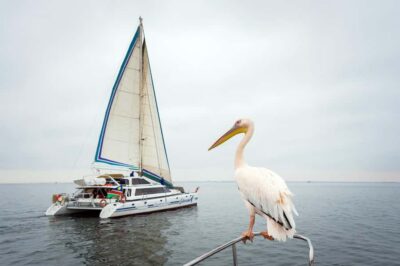
Walvis Bay: Marine Big 5 Luxury Catamaran Tour
Read our review →
Swakopmund: Desert Dunes Quad Biking with Optional Sandboard
Read our review →


Sandwich Harbour Adventure: Seals and Sandwich harbour dune drive
Read our review →
Swakopmund: Little Five Desert Wildlife Quad Biking Tour
Read our review →
Browse the lists this tour appears in